*The pattern may be different from the image shown due to the cutting process


Detail
| Product : | Sukiya Bukuro (A Pouch) (Tea-things) (Tō-sai Yūba-mon) |
|---|---|
| Type : | Sukiya Bukuro |
| Size (cm) : | W21.0×H15.0×D3.0 |
| Tags : | 130th anniversary object-3、 seventh sign of Chinese zodiac (The Horse, 11am-1pm, south, May)、 Wrapping available、 Noon、 Oriental Zodiac、 Pattern_Tō-sai Yūba-mon、 Tea utensils、 horse、 |
| Other : |
Please note that due to cutting, the pattern placement may differ from the displayed image. Product photos may appear slightly different in color from the actual item due to lighting conditions and your device's display settings. |
| Other : | Gift wrapping service available |
Reviews


Description
This is a small container for small items necessary for the tea ceremony. It can be coordinated with the Fukusa and Kaishi Iri. The unique pattern is also fashionable for use as a sub-bag for everyday use.
We have carefully crafted this product, even in places where it is not visible. For those who do not practice tea ceremony, it can be used as a makeup pouch or back-in-bag. It is a good size for keeping small items that are scattered around in a bag.
The lining is lined with Tatsumura's original name.
The clasp may differ from the picture. Please note that the clasp may differ from the picture.
Product Utilization "Sukiya-bukuro

Sukiya-bukuro" is one of our popular products. Originally a tea ceremony utensil, it has been well received for its convenience and usability that goes beyond that.
Click here to continue reading "Sukiya-bukuro" version
Patterns
Tō-sai Yūba-mon(Galloping Horse Design on the White Porcelain)

"AKAE" is a type of Chinese pottery product of which preliminary designs are drawn by red, green, blue, and black glaze on the white porcelain. It influenced far to the European ceramic arts in the Ming Dynasty, China days (14C~17C, AD).
We have modeled one of the "AKAE" designs depicting galloping horses and added the collection of luck-bringing items, like seven treasures, clove, and peony arabesque as symbol of riches and honors.
We have woven into warp-patterned brocade with our exquisite weaving tschnique, the brushwork of the galloping horses and the charm of the "AKAE" of the Ming Dynasty.
Related Related products
-
Tea Basket "BANZAIRAKU" (Kamon Kougei) [WEB Limited]
![]()
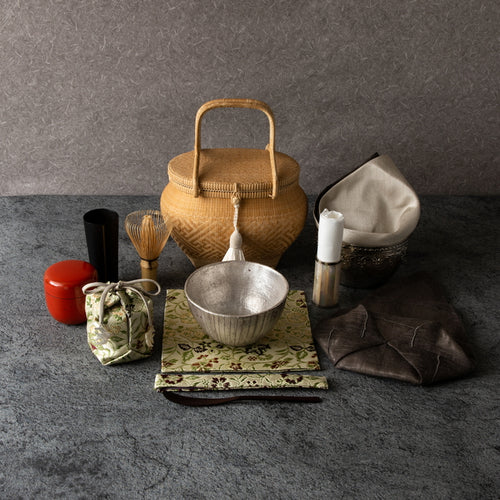
- Regular price
- ¥396,000 (Tax included.)
- Sale price
- ¥396,000 (Tax included.)
- Regular price
-
- Unit price
- per
Sold out -
Tea Basket "TAMATEBAKO" (Kamon Kougei) [WEB Limited]
![]()
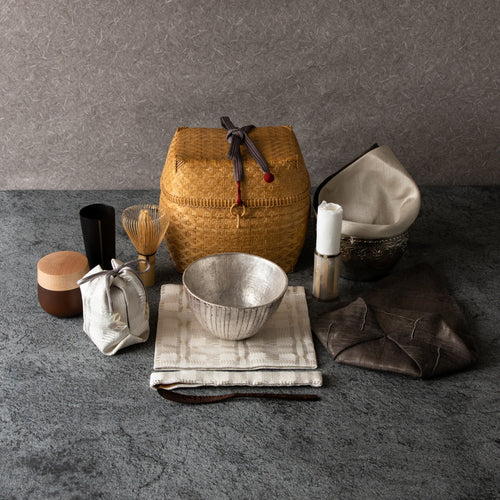
- Regular price
- ¥198,000 (Tax included.)
- Sale price
- ¥198,000 (Tax included.)
- Regular price
-
- Unit price
- per
Sold out -
Tea Basket "KIRARA" (Kamon Kougei) [WEB Limited]
![]()

- Regular price
- ¥105,600 (Tax included.)
- Sale price
- ¥105,600 (Tax included.)
- Regular price
-
- Unit price
- per
Sold out -
Ko-bukusa Cloth (Tea-things) (Web Only) (Budo Karakusa-mon Nishiki)
![]()

- Regular price
- ¥6,050 (Tax included.)
- Sale price
- ¥6,050 (Tax included.)
- Regular price
-
- Unit price
- per
Sold out